Castling in Chess: Rules, Notation and When You Can't Castle
Castling is the only move in chess where you move two pieces at once: your king and one of your rooks. It tucks the king away to safety and brings the rook towards the centre.
How to castle
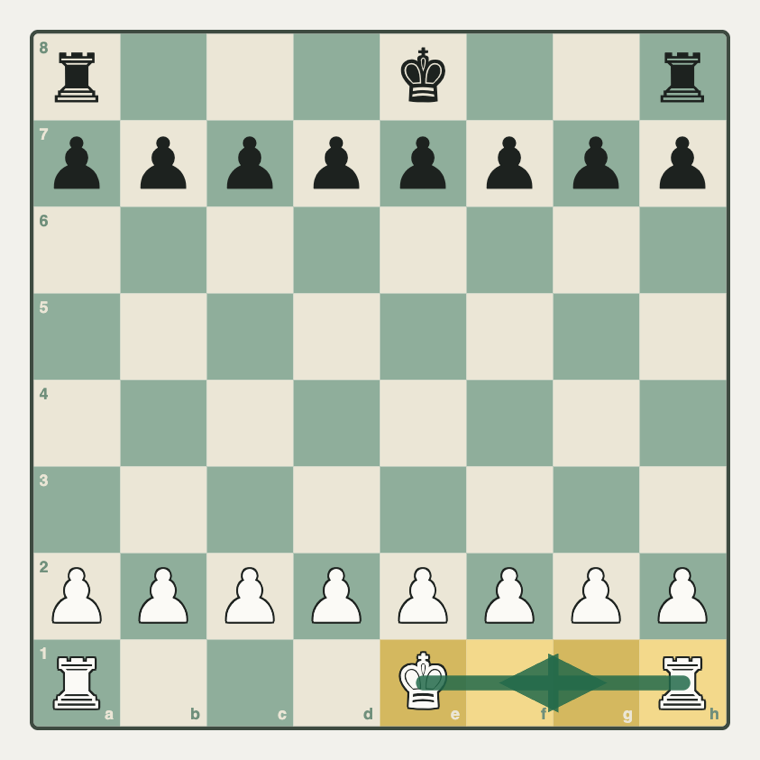
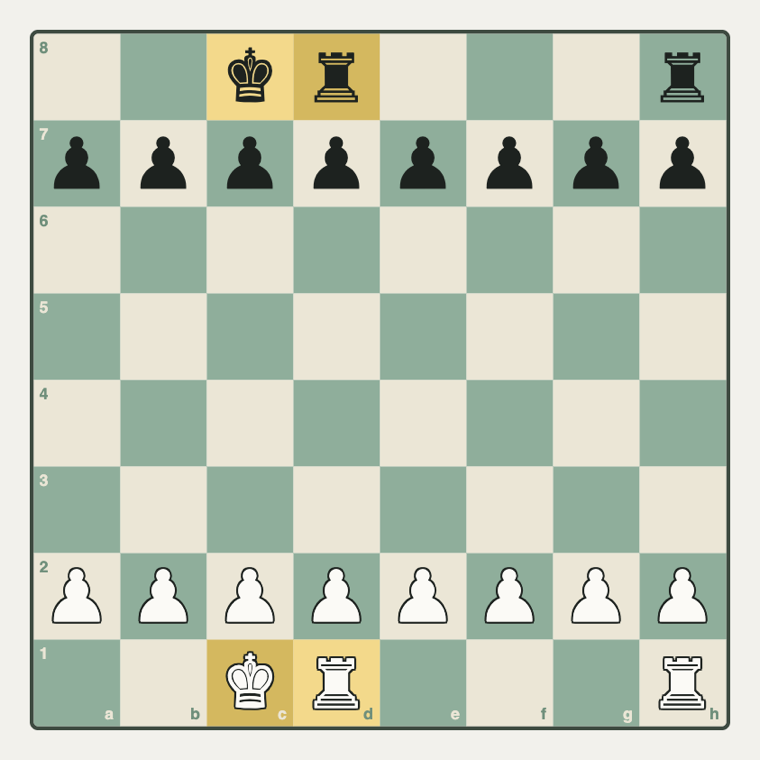
Move your king two squares towards one of your rooks, then place that rook on the square the king just passed over.
- Kingside (short castling): the white king goes e1→g1 and the rook h1→f1. For Black, e8→g8 and h8→f8.
- Queenside (long castling): the white king goes e1→c1 and the rook a1→d1. For Black, e8→c8 and a8→d8.
When you can castle
All five conditions must be met:
- Your king has not moved yet in this game.
- The rook you castle with has not moved yet.
- There are no pieces between the king and that rook.
- Your king is not in check.
- Your king does not pass through or land on a square attacked by an enemy piece.
Note what's not on the list: the rook may be under attack, and in queenside castling the rook may pass over an attacked square (b1 or b8). Only the king's path matters. You can also castle after being in check earlier in the game, as long as your king never moved.
How to write castling
Kingside castling is written O-O and queenside castling O-O-O. See our chess notation guide.
Touch the king first
In over-the-board games, always move the king first. Castling counts as a king move, and under the FIDE Laws of Chess, touching the rook first can oblige you to make a rook move instead of castling.
Which side should I castle?
Kingside castling is quicker (only the knight and bishop need to move out of the way) and usually leaves the king safer. Queenside castling takes longer but puts the rook straight onto the d-file, and players sometimes use it for sharp attacks with pawns on opposite sides.
Castling and en passant are the two special moves every player needs to know. For the basics, see how each piece moves.