Chess Notation Explained: How to Read and Write Chess Moves
Chess notation lets you write down a game, replay famous games from books and follow analysis online. Almost everyone today uses algebraic notation.
Naming the squares
Each square has a name made of a letter and a number. The columns (files) are labelled a to h from White's left to right, and the rows (ranks) 1 to 8 starting from White's side. So the white king starts on e1 and the black queen on d8.
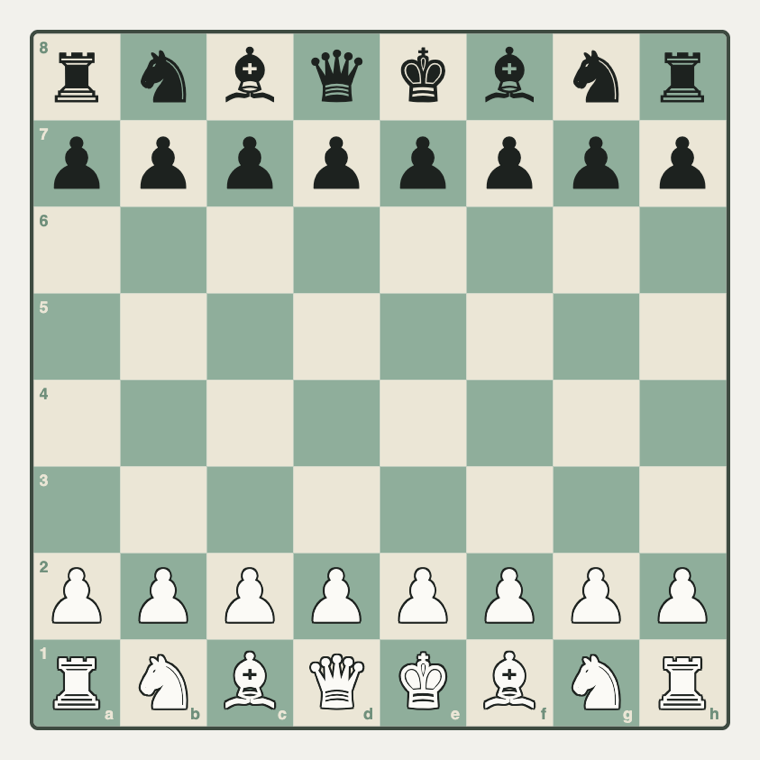
Writing a move
Write the piece letter followed by the square it moves to:
| Piece | Letter | Example |
|---|---|---|
| King | K | Ke2 |
| Queen | Q | Qh5 |
| Rook | R | Rd1 |
| Bishop | B | Bc4 |
| Knight | N | Nf3 |
| Pawn | (no letter) | e4 |
The other symbols
| Symbol | Meaning | Example |
|---|---|---|
| x | Capture | Bxf7, exd5 (pawns use their file letter) |
| + | Check | Qh5+ |
| # | Checkmate | Qxf7# |
| O-O | Castling kingside | O-O |
| O-O-O | Castling queenside | O-O-O |
| =Q | Promotion | e8=Q |
| e.p. | En passant | exd6 e.p. |
When two pieces can go to the same square
Add the file (or rank) the piece comes from. If knights on b1 and f3 can both reach d2, write Nbd2 or Nfd2. If rooks on e1 and e7 can both reach e4, write R1e4 or R7e4.
Numbering moves
Each move number covers one move by White and one by Black: 1. e4 e5 2. Nf3 Nc6 3. Bb5 is the opening of the Ruy Lopez. If you're starting from Black's move, use three dots: 3... a6.
! and ?
Annotators add symbols to show their opinion of a move: ! good, !! brilliant, ? a mistake, ?? a blunder, !? interesting and ?! dubious.
Older notation
Older English books use descriptive notation, where 1.e4 is written P-K4 (“pawn to king four”). Computers store games in PGN files, which use algebraic notation.
Practise reading notation with Scholar's Mate and Fool's Mate, or find annotated classics in our chess books collection.