What Is Stalemate in Chess? Rules and Examples
Stalemate happens when the player whose turn it is has no legal move but is not in check. The game ends immediately and is a draw, no matter how much material either side has.
Stalemate v checkmate
- Checkmate: your king is in check and you have no legal way out. You lose.
- Stalemate: your king is not in check, but every move you could make is illegal (usually because it would walk your king into check). It's a draw.
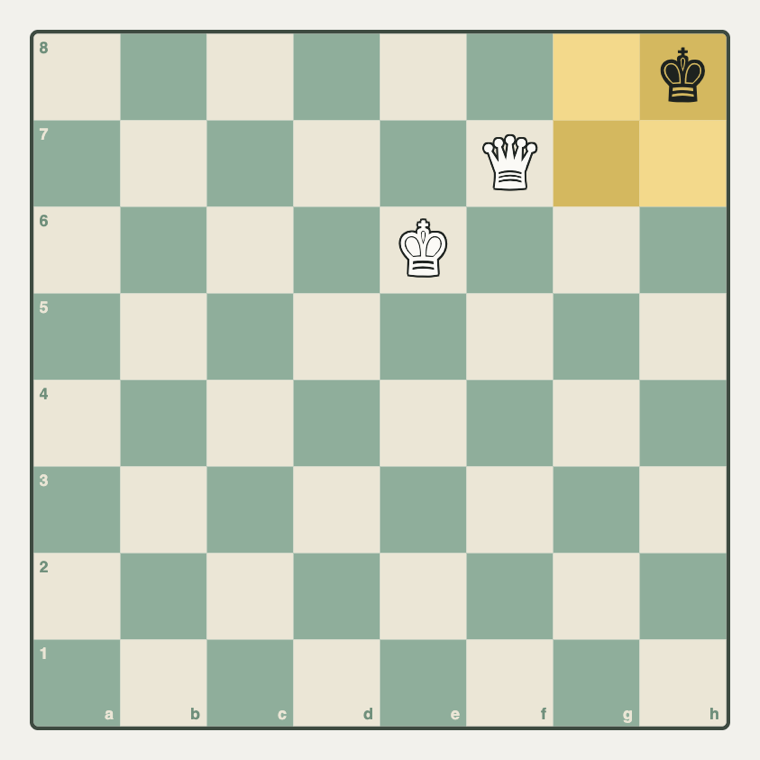
In the diagram the black king on h8 isn't attacked, but every square it could go to (g8, g7 and h7) is covered by the white queen, and Black has no other pieces. With Black to move, that is stalemate.
How to avoid stalemate when you're winning
Stalemate is the classic way to throw away a won game, especially with a queen against a lone king. A few habits help:
- Before every move, ask: “After this, does my opponent have a legal move?”
- Don't take away all of the enemy king's squares unless you are also giving check.
- Bring your own king up to help: a queen and king working together mate quickly and safely.
- Be careful when your opponent has only a king and a few blocked pawns: if the pawns can't move either, a stalemate is close.
Using stalemate to save a lost game
If you're losing, stalemate can be your friend. Look for ways to get rid of your remaining pieces, or tuck your king into a corner, so that you have no legal moves.
Stalemate is one of several ways a game can be drawn. Read all 7 ways a chess game can end in a draw.