Scholar's Mate and Fool's Mate: The Fastest Checkmates in Chess
Two short checkmates catch out beginners everywhere. Knowing them means you will never fall for them, and you'll recognise the idea behind them: an early attack on a weak point next to the king.
Fool's Mate: checkmate in two moves
Fool's Mate is the fastest possible checkmate in chess. It only happens if White weakens the diagonal next to the king very badly:
1. f3 e5 2. g4 Qh4#
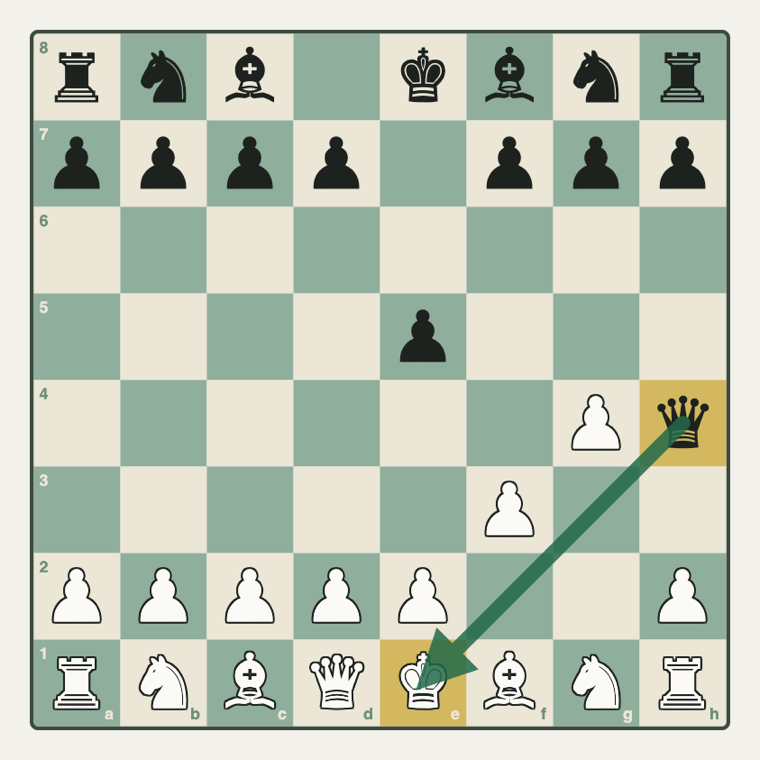
The black queen checks the white king along the diagonal that the f- and g-pawns used to guard, and nothing can block or capture her. The same mate can happen with 1.f4 or 1.f3 and a slightly different first move by Black. The lesson: don't push the pawns in front of your king early on, especially the f-pawn.
Scholar's Mate: checkmate in four moves
Scholar's Mate targets the f7 square (f2 for White), which at the start of the game is only defended by the king. One common move order:
1. e4 e5 2. Bc4 Nc6 3. Qh5 Nf6?? 4. Qxf7#
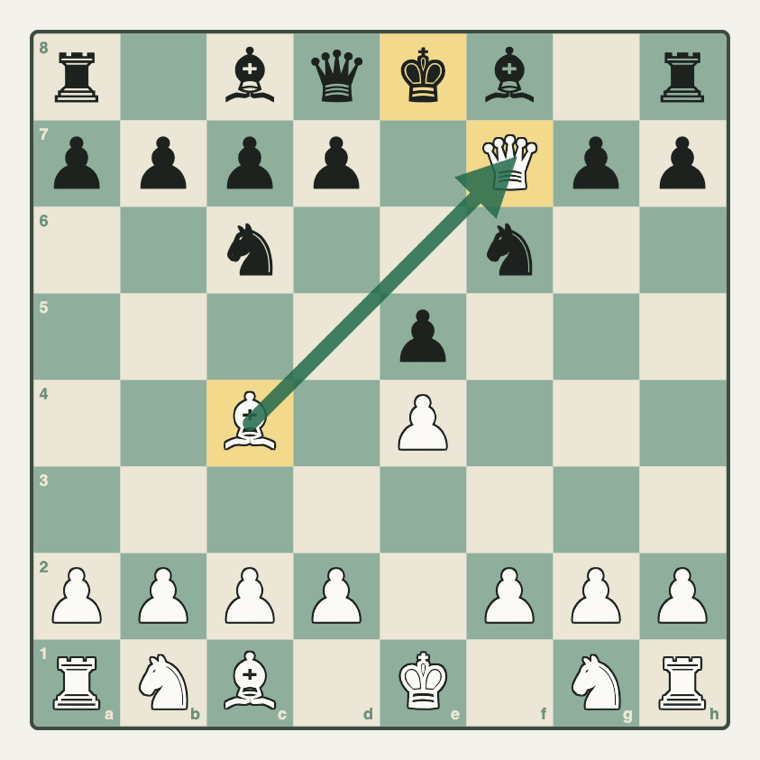
The queen takes on f7, protected by the bishop on c4, and the black king has nowhere to go.
How to stop Scholar's Mate
- After 3.Qh5, defend both the e5 pawn and f7: 3...g6 blocks the queen's path to f7, and 3...Qe7 guards f7 directly.
- If White plays an early Qf3 instead, ...Nf6 blocks the queen's attack on f7.
- Once the attack is blocked, the white queen is often exposed. Develop your pieces with tempo by attacking it.
Should you play Scholar's Mate?
It can win quick games against complete beginners, but against anyone who knows the defence it leaves your queen out early and your development behind. It's better to learn sound opening principles. To read and write moves like the ones above, see our chess notation guide.